

Pedagogy
Design Studio Environment
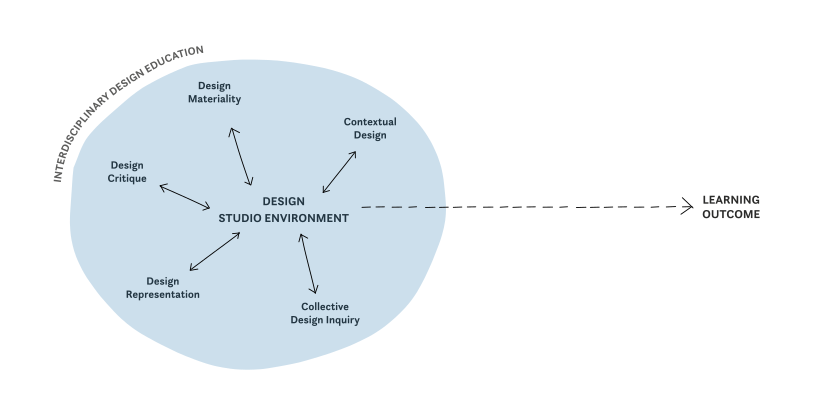
The design studio provides the foundation for interdisciplinary design education. It creates a practice-based learning environment that supports experimentation, iterative learning, critique, and collaboration.
Signature pedagogies
Interdisciplinary design education is characterised by six interconnected pedagogies. Together they provide a foundation for learning that supports inquiry, collaboration, creativity, and critical reflection across disciplinary boundaries.
Pedagogy
The design studio provides the foundation for interdisciplinary design education. It creates a practice-based learning environment that supports experimentation, iterative learning, critique, and collaboration.
Pedagogy
Students engage with authentic challenges situated within real-world contexts. Through research, ideation, prototyping, and testing, they learn to navigate complexity and uncertainty.
Pedagogy
Learning occurs through collaboration, co-creation, and interdisciplinary dialogue. Students work with others to frame problems, generate ideas, and develop shared understandings.
Pedagogy
Students engage with physical, digital, and conceptual materials as a way of thinking, exploring, and making. Material engagement becomes a vehicle for learning and knowledge creation.
Pedagogy
Visualisation, storytelling, sketching, prototyping, and other representational practices support communication, reflection, and the development of design ideas.
Pedagogy
Structured critique enables students to reflect on their work, receive feedback, evaluate alternatives, and refine solutions through ongoing dialogue.